Luxe, Calme et Volupté: Painting the French Riviera
Luxe, Calme et Volupté: Painting the French Riviera
Royal Academy of Arts, London, Oct 2, 2026 – Jan 31, 2027
I think that one of the signs that makes an exhibition important for me as an artist is when I leave the gallery and rush back to my studio, impatient to get down to work. This joyful, exuberant, inspiring, imaginative show at the RA has had this effect on me but has brought back a memory that I had consigned to the dustbin of my failures. Full disclosure; a while back I decided that I needed a shake-up in my work. I loaded up my car with a large canvas, a long roll of plastic sheeting and a box of oil paints and I took off to a small hotel in Collioure, a small Mediterranean fishing port on the corner of France and Spain. Collioure has long been an important place for generations of artists, from Charles Rennie Mackintosh to André Derain to Henri Matisse.
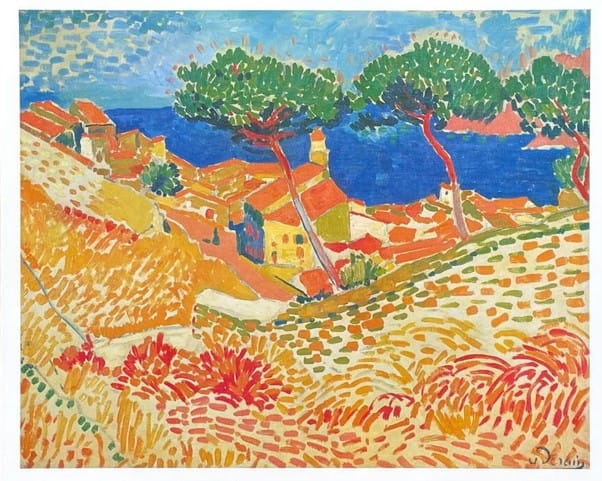
I rented a room with a balcony, overlooking the port, with almost the same view of the harbour as in Matisse’s Open Window Collioure of 1905. This painting is a milestone in Matisse’s oeuvre, and is canonical in the history of art. It breathes abstraction whilst remaining figurative. It is about the liminal, the edges of things, and depicts what Willem De Kooning called “the inside and the outside at the same time.” My sort of subject. The show includes a wonderful View of Collioure from the same year by André Derain, on loan from Museum Folkwang, Essen.
André Derain View of Collioure, 1905
Geographically, Collioure should not really feature in a show about the French Riviera with Antibes, St Tropez, Nice, and Cannes being the usual suspects. But its inclusion in this show has reminded me that Baudelaire’s “luxe, calme et volupté” that attracted so many artists to the Midi can be a double-edged sword, one on which I fell very badly.
Epiphanies for some, but not for me.
In Collioure, I primed myself for a week of determined solitude and hard work. I asked the hotelière, who knew that I was painting, not to disturb my room. I spread plastic over the floor and the bed which served as a work table during the day. It was a very small room. I prepared. I had rented this room before, on a scouting mission. Never before to work.
I began.
Every evening, when I took my aperitif in the bar, the proprietor would ask me how I was getting on. After a week, I took the canvas down to the beach in front of the hotel, and I ceremonially set it on fire. She must have smelt the bonfire of my vanity because she came down to have a look at the smouldering embers. She was silent for a bit and then said, with some sympathy, “if you think you are the first artist to rent this room to paint, with this sad result, you are very much mistaken”.
I was taken aback.
“Why do you think that is?” I wondered.
She looked at me with pity “Après Matisse? Mais vraiement?”
Today, at the Royal Academy, I remembered my week of artistic hubris. Whilst Collioure is not strictly on the French Riviera, there are some magnificent paintings of Collioure in this show that I have never seen before and that brought back the painful memory but also unadulterated joy. Of course, Matisse. Wonderful, surprising Braque and Derain. Of course, Monsieur Picasso in his exuberant splendour.
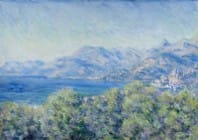
Claude Monet View of Ventimiglia, 1884
Many artworks have come from private collections and far-flung museums. I have never before seen Monet’s Bordighera or Ventimiglia paintings from the 1880s, and I thought I knew his work very well. We move through a whole century of art, from Impressionism in the 1870s right up to avant-garde performance art in the 1960s. The show could serve as an introduction to Modernism. With cinema thrown in too. A gallery is devoted to the many movies made on the Riviera from Powell and Pressburger’s Red Shoes to Hitchcocks’s To Catch a Thief, with a beauteous, luminous Grace Kelly and suave Cary Grant navigating the tortuous hair pin bends of the Corniche. They are the epitome of Riviera decadence in their nifty little convertible.
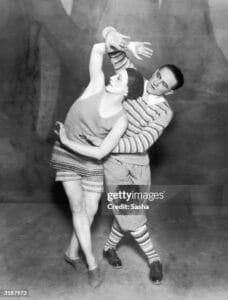
Le Train Bleu, Diaghilev’s Ballet Russe, 1924
The development of the railways in France enabled easy travel (with the famous train bleu from Paris) and one gallery is devoted to originals of those gorgeous travel posters so beloved of ersatz French cafés and bistros all over the world. There is graphic art, ballet, and photography, ceramics and sculpture. Each artist, and there are far too many to mention here, is given an intense mini one-man show. (The impressionist Berthe Morisot and her daughter Julie Manet are the only female artists represented.) We start with Cézanne at L’Estaque in the mid-1870s in the glory days of Impressionism, and we end with the Anthropometric art of Yves Klein in the 1960s. The design of the show works on a subliminal level, and one feels bathed in the azure waters of the Mediterranean. Bonnard’s sun-drenched work at Le Cannet gleams in the bright sunlight. Even the programmatic, austere pointillist visual experiments of Seurat, Signac and Cross look positively luscious. The gallery walls imperceptibly change from a deep azure for Cézanne in the first gallery, to a delicate light blue in the penultimate room dedicated to the much underrated Nicolas De Staël. To see De Staël in such intimacy is a privilege and corrects the sad fact that he is so little known outside France.
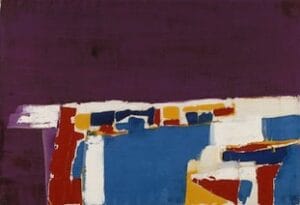
Nicolas De Staël View of Marseille, 1955
This show proposes the Riviera as heaven on earth. An Arcadian escape from Paris and the Northern winter climes, and in subsequent years also an escape from the German occupation. Free France.
I don’t think I have to repeat my painful experiment in Collioure.
I will just move into the Royal Academy.