Vanessa Bell & Duncan Grant, Inside Bloomsbury
Tate Britain. 12 November, 2026 – 11 April, 2027
and
The Papeterie de Vaux, Payzac, France
Robin Richmond, November 11, 2026
I am a painter and a committed craftsperson. I am a fallible decorator (good with colour but impatient with skirting boards), an inspired restorer of furniture (I am good at faking antiquities having watched the masters on the Via dei Coronari in Rome in my childhood), a so-so muralist (my frescos are liable to crack), a terrible knitter (I have to use huge needles), an enthusiastic but mediocre potter (I can hand build but not throw), a slow embroiderer (50 centimetres of the Bayeux tapestry done in the Bayeux stitch took me 31 years), a fabric designer (I am good with prints but cannot make garments as I can’t understand armholes), a dynamite paper maker (more later), an impatient printmaker (my etchings are too variable to be considered an edition) and a mad Felter (my cobweb shawls are more holes than wool).
Most of these side hustles are not worthy of a public airing, but for me they serve to uncouple monetary value from the sheer joy of making things, just for the fun of it. Craft work. I think.
But what is the difference between art and craft? In my case it has to do with money, as only my paintings are for sale, but after seeing this show at Tate Britain, I am vexed anew by this question. Vanessa Bell and Duncan Grant, two “Bloomsberries” who according to Dorothy Parker “lived in squares, painted in circles, and loved in triangles”, didn’t seem to make a distinction. Their painting and their decorative work flow into each other. A Bloomsbury circle. What defines craft and what defines art? Why is one sphere of activity more expensive and prized than the other? Is to do with seriousness? Materiality? Usage? Context? Accessibility? Complexity? Design? Subtlety? Commitment? Intellectual gravitas? Intentionality?
I don’t know the answer to any of this, but I was hoping that a visit this morning to Tate Britain might help me out. In my student days, a devotion to Vanessa’s sister, one Virginia Woolf, and later to the work of the Bloomsbury Group (my art school thesis was on the painter Mark Gertler) led me to wander Gordon Square. This was Vanessa and Virginia’s London home.
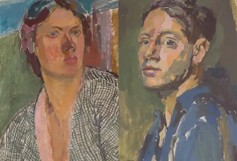
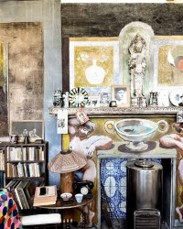 Self Portraits by Vanessa Bell (c. 1911) and Duncan Grant (1920). The studio at Charleston.
Charleston, East Sussex. set in pastoral countryside, was the crucible of a fifty-year creative partnership between two painters. Sometime lovers, devout Europhiles, and fellow modernists, the painters Vanessa Bell (1879 -1961) and Duncan Grant (1885 – 1978) enjoyed a communal intellectual life in their privileged retreat, with Clive Bell, Lytton Strachey, Roger Fry and many others. Visiting the house is to do a deep dive into the lives and loves of two indefatigable minds. Unconventionally polyamorous triangular relationships, both gay and straight, were lived in this house where every bit of wall and furniture is decorated or sewn or cobbled together. Grant and Bell seem to have made no bones about the difference between art and craft. It is one and the same. It’s what’s called “lifestyle” these days. Their paintings and their decorative objects fit their aesthetic philosophy, and their art historical grounding is tangibly and profoundly influenced by post Impressionism. Matisse, Picasso, Van Gogh and Gauguin are ghosts at the feast. Manet and the Post Impressionists, a seminal show curated by fellow Bloomsberry Roger Fry in 1910, enchanted them, as did the landscapes of Italy and France. But there is a curious bleaching, chalky tonality in the painting that works better when seen on their craft creations. There is one notable exception. I find the paintings of two such sexual libertarians oddly unsensual and sexless, except for the small side gallery devoted to Duncan Grants explicitly homoerotic sketches….
Grant and Bell were founder members and directors of the Omega Workshop, founded in 1913. This was a modernist design collective, with a dedicated communitarian ethos, that made everything from clothes to upholstery to furniture to wallpaper to book covers. As the shared studio at Charleston is undergoing major restoration right now, the Tate has transplanted it to Pimlico SW1. It looks false and theatrical and betrays its origins.
The show has over 300 paintings and sets them into the atmosphere of Omega and sadly they do not fare that well. I have just returned from Italy and don’t recognise the dusty, sombre, sullen palettes of either Vanessa or Duncan’s Italian paintings. Where is the colour? Where is the light? Where is the joy? Farrow and Ball, maker of superior paint, is responsible for the wall colours that leach colour away from the tonally subdued paintings at Tate Britain. A particularly acidic Pernod yellowy green set my teeth on edge. Compared with the decorative flourishes of the Omega workshop objects, the paintings are strangely inert and banal.
Does Craft win over Art here? Perhaps it is a symbiosis. Are they mirror versions of each other? I don’t yet know.
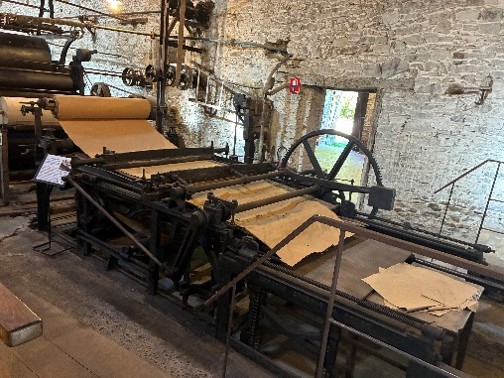
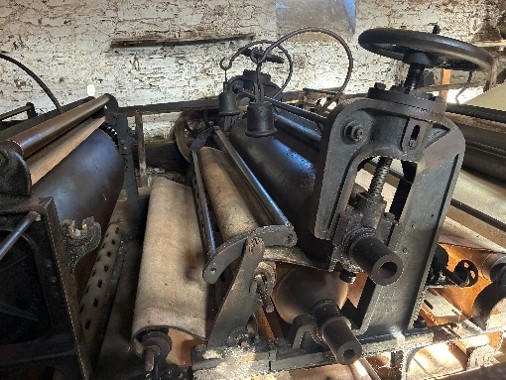
Paper making machinery at La Papeterie de Vaux, Payzac, France.
But I do know that art needs craft and craft needs art. This came to me forcibly when I, a dedicated maker of my own paper, chanced upon an ancient craft in an old water mill and forge near to where I live and work in France. This mill is fed by the water of the small Ruisseau des Belles Dames, which is in turn fed by the Auvezère river. It is the only old paper mill in perfect condition in Europe and has been in existence since 1861. It still produces small amounts of paper, and having acquired some, I am loving its texture and its history. The mill has not fully functioned since 1968 when it last produced the huge, deliciously sensual pale-yellow bales of rye straw paper that were sent out to Reunion and Mauritius to wrap bananas.
Vanessa and Duncan would have loved it.
Craft. Not for art, but for bananas.
“Not for ambition or bread
Or the strut and trade of charms
On the ivory stages
But for the common wages.”
Dylan Thomas
From My Craft and Sullen Art
(Deaths and Entrances 1946)